

Frank Ikechukwu Igwealor's 'Cashing Out Without Selling Out,' Guides Business Owners Could Get Liquidity Without Selling
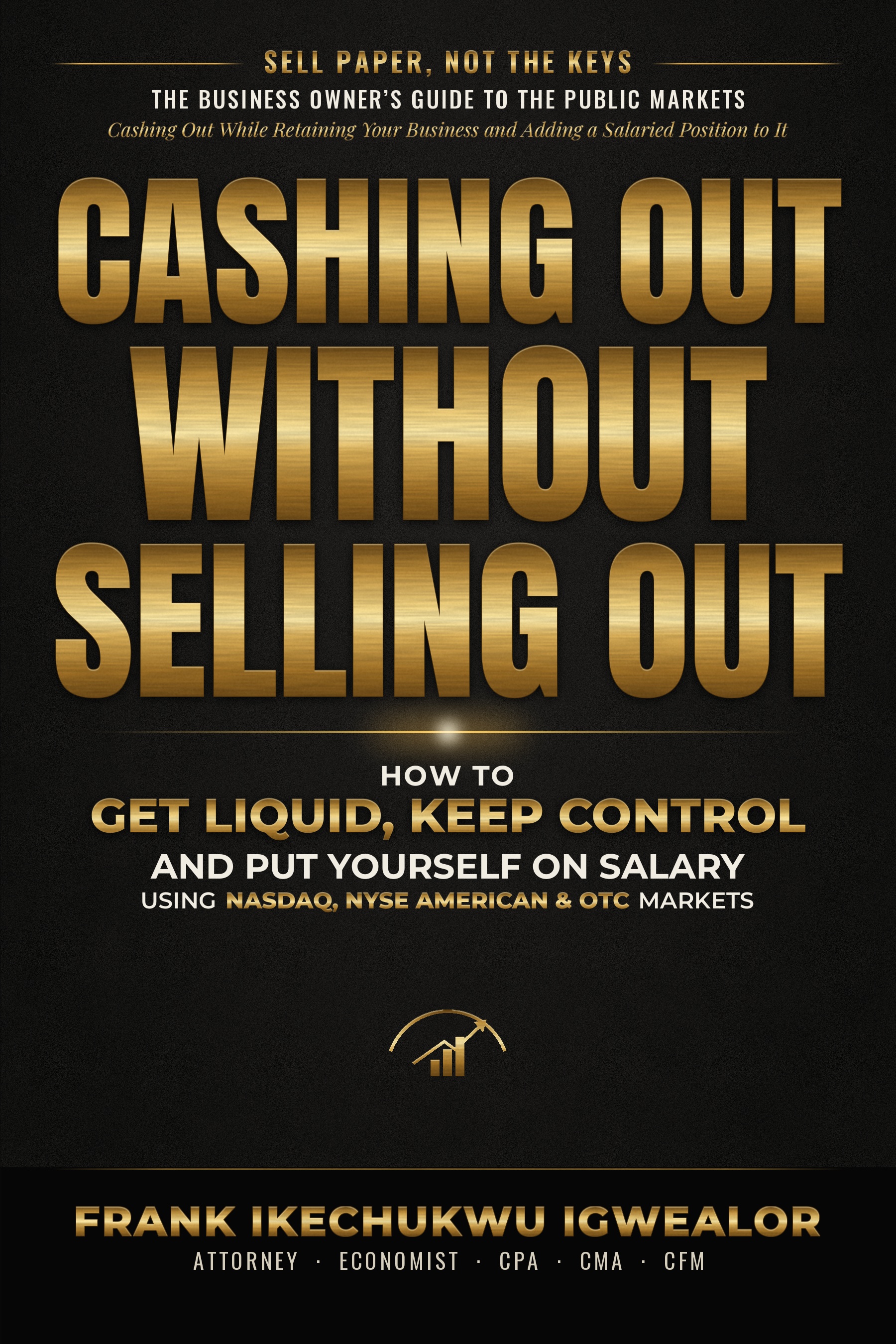
CASHING OUT WITHOUT SELLING OUT
New book shows business owners how the public markets can turn part of a lifetime of equity into cash, while the owner keeps control and stays on as a salary.
LOS ANGELES, CA, UNITED STATES, October 6, 2026 /EINPresswire.com/ -- Attorney, economist, and certified public accountant Frank Ikechukwu Igwealor today announced the release of Cashing Out Without Selling Out: How Business Owners Can Use the Capital Markets to Unlock Wealth and Liquidity, Keep Control, and Stay Compensated. The book is now available in paperback and Kindle editions on Amazon and through other major booksellers.The book begins with advice that nearly every successful private business owner eventually hears: you cannot eat equity. Sooner or later, the owner is told, there are only two choices. Keep the business and keep nearly all of your wealth locked inside it, or sell it, take the money, and walk away. Igwealor argues that this advice correctly identifies the problem but offers an incomplete list of options.
There is, he writes, a third door. A qualified owner can sell a slice of the company to public investors, keep control of the whole, and put himself or herself on a real, board-approved salary as chief executive of the enterprise he or she built. The owner turns part of the business into cash, keeps a large retained stake that continues to compound, and gains for the company something private businesses rarely have: continuous access to capital.
"For most of my professional life I have sat on the issuer's side of the table, and I have watched owners arrive at the same crossroads again and again," said Igwealor. "They have built something valuable, and almost everything they own is tied up in a single company that could be damaged by one lost customer, one lawsuit, or one bad year. They are told to stay illiquid or sell. That advice is incomplete. This book exists to show them the third door, and to be honest about what lies behind it."
Sell Paper, Not the Keys
The organizing idea of the book fits in a single sentence: sell paper, not the keys. Igwealor breaks that principle into three commitments that run through all fifteen parts and thirty-one chapters. Liquidity is a percentage: the owner decides how much cash is actually needed, sells a modest amount at the offering, and sells more over time at prices the market has validated. Control is a structure: voting power, board composition, and protective provisions are designed deliberately before the offering, with a decade of future dilution in view. Salary is a contract: the owner's role and compensation are secured through an employment agreement approved by independent directors, so the owner can live on salary and manage shares rationally.
The book follows the logic of a real transaction, from the owner's first question to the morning after the listing. It explains what going public really means and how a Nasdaq or NYSE American listing differs from an over-the-counter quotation. It covers valuation and dilution, how to prepare the business and clean up the corporate house, and how to structure primary and secondary share sales. It compares the available pathways: the traditional underwritten IPO, Form S-1 registration, Regulation A+, direct listings, reverse mergers, SPAC mergers, and uplisting. Later chapters address keeping control through dual-class shares and the controlled-company exemption, setting defensible founder compensation, and converting equity into personal cash through Rule 144, lock-ups, Rule 10b5-1 trading plans, registered secondaries, and borrowing against shares.
The book also devotes substantial space to the costs of public life: SEC reporting, the real annual expense of staying listed, insider-trading rules, investor relations, and enforcement. It closes with situation-specific playbooks, case studies, and a step-by-step Cash-Out-Without-Exit Blueprint that owners and advisers can use as a working plan.
Honest About the Limits
Igwealor is direct about what the book does not promise. Going public, he writes, is not easy, not cheap, and not right for every business. A public listing is not an automated teller machine, an OTC quotation is not the same as a Nasdaq listing, and a reverse merger into a dormant shell is not a shortcut to wealth. An entire part of the book, "When Going Public Is the Wrong Answer," walks owners through alternatives such as a private recapitalization, a minority sale to a fund, sensible debt, or an outright sale.
"The goal is not to sell anyone a listing," Igwealor said. "Some of the most painful outcomes I have seen came from owners who believed a public company was a shortcut. For a business that fits — profitable or close to it, with auditable books, a credible growth story, and an owner willing to live in public — the capital markets offer liquidity without surrender. For everyone else, the book explains why another path is better, and how to recognize a bad proposal when one is placed in front of you."
Each section closes with Sources and Evidence Notes that grade every significant figure, from primary sources such as SEC rules and exchange rulebooks to illustrative examples, which are clearly labeled as teaching devices rather than recommended structures.
Who the Book Is For
Cashing Out Without Selling Out is written for owners of established private businesses who have built real value and want some of it in cash without handing the company to someone else. Typically these owners have several years of operating history, revenue in the millions or tens of millions of dollars, profits or a clear path to them, and financial statements that are audited or could be.
The book is also written for the advisers around those owners, including accountants, corporate lawyers, wealth managers, and bankers, who are often asked about going public and rarely given a framework for answering. It is not written for idea-stage founders raising a first round of venture capital, and it is pointedly not written for anyone who believes an over-the-counter quotation is a guaranteed payday.
Eleven appendices provide practical working tools: a listing standards comparison, a pathway comparison matrix, a 100-point readiness scorecard, a pre-filing readiness checklist, a founder employment agreement term sheet, a control-and-liquidity term sheet template, a dilution worksheet, a Rule 144 resale worksheet, a Rule 10b5-1 plan outline, a glossary of capital markets terms, and a guide to regulatory sources.
"Cash out. Stay in. Keep building," Igwealor said. "That is the whole book in six words. The owner's choice does not have to be 'keep the company or sell the company.' A properly structured transaction can let an owner monetize part of what he built, keep meaningful ownership and control, draw a salary for leading the enterprise, and give the company access to capital for its next stage of growth."
Book Details
Title Cashing Out Without Selling Out: How Business Owners Can Use the Capital Markets to Unlock Wealth and Liquidity, Keep Control, and Stay Compensated
Author Frank Ikechukwu Igwealor, Attorney · Economist · CPA · CMA · CFM
ISBN 979-8-951213-19-8 (Paperback)
Format Paperback (6 × 9 in., approx. 510 pages) and Kindle eBook
Price $50.00 paperback; $9.99 Kindle
Release Date September, 2026
Availability Amazon: https://www.amazon.com/dp/B0HLL4XLG9
About the Author
Frank Ikechukwu Igwealor is an Economist, a California licensed attorney, a Certified Public Accountant, Certified Management Accountant, and Certified Financial Manager. Igwealor is also a California licensed Real Estate Broker since 2005.
Igwealor's education includes degrees in Accounting, Economics, Business Administration, Risk Management, and Law. Igwealor lives in Los Angeles and has worked as officer and director of numerous public and private companies in the United States, Europe, Asia, the Middle East, and Africa. Frank is also a local Pastor of a little Charismatic congregation in Los Angeles.
Over the years, Frank has authored more than 20 books on Economics, Philosophy, Politics, Religion, Faith, Finance, Stock Markets, Trading, and life in general.
Other Books by the Author
•10x Compounding Blueprint
•10X Stock Finder
•African Development Paradox
•Betrayal
•Failure Intelligence
•Family Faith and Finance
•Fatal Blunders
•Momentum Investing Cheat-Code
•0DTE Strategy for Consistent Outperformance
•Swing Trader's Blueprint
•The Black Republican
•The Entrepreneur's Blueprint
•The Fallacy of Reciprocity of Generosity
•The Forbidden Romance
•The God of Abraham, Isaac and Israel
•The Igbo Identity
•The Roots of African Poverty
•Why Christians Cannot in Good Conscience Support or Vote for the Democratic Party
Frank Ikechukwu Igwealor
Frank Ikechukwu Igwealor
Legal Disclaimer:
EIN Presswire provides this news content "as is" without warranty of any kind. We do not accept any responsibility or liability for the accuracy, content, images, videos, licenses, completeness, legality, or reliability of the information contained in this article. If you have any complaints or copyright issues related to this article, kindly contact the author above.
